Using Satellites to Find a Breath of Fresh Air
Under the guidance of Dr. Nabin Malakar, Worcester State students are tracking air quality, from space to the streets.
By Nancy Sheehan
While high-tech satellites orbit hundreds of miles above the Earth, a group of students is bringing that data back down to the pavement. Led by Dr. Nabin Malakar, associate professor in the Department of Earth, Environment, and Physics, a new research initiative is blending “big data” with neighborhood-level action to tackle the invisible threat of air pollution.
The project addresses a critical gap in environmental monitoring. Traditional monitoring stations are expensive and sparse, often missing the hyper-local spikes of the fine particles in the air that affect specific blocks or neighborhoods. By integrating ground measurements with satellite and meteorological data, Dr. Malakar’s research reveals when, where, and why these pollution spikes occur.
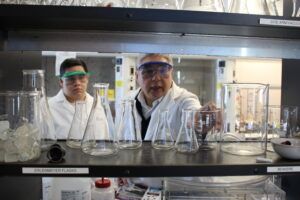
What makes this work especially impactful is that Dr. Malakar serves as a mentor who facilitates experiential learning, ensuring students are at the center of the process while gaining hands-on experience with data collection and coding to solve real problems affecting public health. Some of this research is supported by funds through the Aisiku STEM Undergraduate Research Summer Fellowship grants, NOAA (Department of Commerce) grant and Summer Undergraduate Research Grant (SURG).
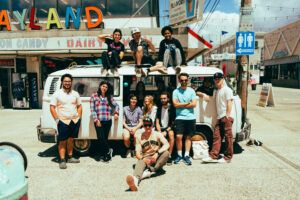
The research team isn’t just crunching numbers; they are bringing lived experience from across the globe to the streets of Worcester. Pola Faris ’27, an international student originally from Egypt, offers a unique perspective on the importance of this work. While using a hand-held device to collect neighborhood data, he is continually impressed by the relatively clean air in the United States compared to his home country.
“Back home in Egypt, you can often see and taste the density of the air,” said Faris, a biology major with a chemistry minor. “Walking through Worcester with a sensor in my hand, I realized that ‘clean’ is relative. Even here, the data shows invisible spikes that people breathe every day without knowing it.”
His firsthand comparisons highlight the global importance of monitoring. “Data doesn’t have a nationality,” he said. “Whether I’m looking at a neighborhood in Massachusetts or a city in North Africa, the goal is the same: making the invisible visible so people can live healthier lives.”
This commitment to clarity and communication is a hallmark of the program’s standout researchers, including Julia Casavant. An exemplary transfer student who found her roots quickly at Worcester State, the biology major first began collaborating with Dr. Malakar during the Summer STEM Bridge Program. Combining rigorous curiosity with strong collaboration, she traced smoke from Western Canadian wildfires across the continent and documented its measurable impact on particulate matter in Massachusetts and Maine. By analyzing complex environmental data, Casavant translated her findings into a visually compelling research poster that illustrates how transboundary wildfire events result in poor air quality across the Northeast.
“Climate change is a universal challenge, and understanding the risks from threats like wildfires is now a matter of public safety,” Casavant says. “Our research shows that smoke and particulate matter can travel thousands of miles to impact the air we breathe right here at home. We should all pay as much attention to our air quality as we do to our food or water, especially for those in high-risk groups.” Casavant hopes her work ensures that the “big picture” of climate events is distilled into clear, actionable information for the public.
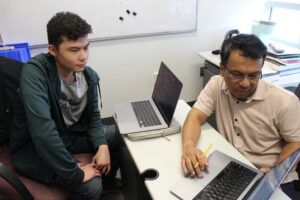
Dr. Nabin Malakar goes over air pollution data with student Islambek Karagulov ’28.
In a similar vein, Islambek Karagulov ’28, a double major in computer science and mathematics, contributes a macro-perspective through his research on transboundary air pollution. He utilizes satellite remote sensing techniques to study how pollution drifts across international borders in South Asia. By applying statistical methods and machine learning algorithms, Karagulov identifies patterns that define the air we breathe.
“The biggest challenge is deriving meaningful knowledge despite the noise or distortion that can exist in the data,” he said. “But leveraging satellite data allows us to cover vast territories—reaching uninhabited mountains and open oceans. We are beginning to observe how pollution levels in major cities link to broader regional trends.”
For students like Emily Walls ’28, a chemistry major and environmental science minor, the project serves as a launchpad for a career in science and advocacy. After participating in the STEM Summer Bridge Program, Walls gained intensive experience in field data collection. She has since become an enthusiastic public speaker, presenting her research via posters and advocating for student engagement in scientific inquiry.
“I realized this data truly meant something when I began comparing our local findings to national trends,” she said. “Not every community has access to air quality monitors, but if these tools were more readily available, they could keep people safe.”
Walls believes this project is more than just a lab credit; it’s a way to gain the confidence and technical skills necessary to back up community advocacy with hard evidence. “Everyone is affected by air quality,” she said. “By enforcing better air quality through policy, we can help not just the United States, but every country that shares our atmosphere. Being a scientist in the 21st century means looking at the big picture to understand the smallest molecular details, because those details impact every living species.”
As Dr. Malakar said, the project does more than advance air-quality research; it builds a scalable, student-driven model for workforce preparation. By immersing students in data analytics and climate resilience, Worcester State is ensuring that the next generation of scientists is ready to tackle the environmental challenges of the future. The transition from space-based observations to street-level solutions creates a powerful loop of discovery, where global data informs local action and students are prepared to lead in a changing world.