Building a life of service
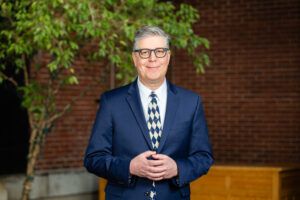
Omer Rafiq ’14—recipient of the 2025 Outstanding Young Alumnus Award—has dedicated his career to serving his fellow Americans as a U.S. marine and more.
By Emily Gold Boutilier
During the final days of the U.S. military presence in Afghanistan, Omer Rafiq ’14 was on the ground in Kabul, evacuating hundreds whose lives were in peril under Taliban rule.
He and his team are credited with directly rescuing 675 people.
Two years later, as civil war erupted in Sudan, Rafiq arrived in the country on an allied nation frigate and became one of two U.S. Department of Defense officials on the ground for the military-assisted departure of Americans and allied nationals.
These two moments capture the essence of Rafiq’s career in public service, which has brought him to more than two dozen countries in military and civilian roles. These roles include serving as senior advisor in the Office of the Secretary of Defense; as director of strategy and plans for U.S. Central Command at the U.S. Embassy in Riyadh, Saudi Arabia; as a legislative fellow in the U.S. Senate; as an infantry officer in the U.S. Marine Corps; and more.
His path begins with his immigrant story. Born and raised in Saudi Arabia to parents of South Asian and Middle Eastern descent, Rafiq was a young teenager when his family won the U.S. green card lottery. They moved to the Worcester area, where Rafiq’s oldest brother was already working in tech. “You go where you have roots—we had one root,” Rafiq said.
Those early years in Massachusetts were challenging. As a high school senior, Rafiq was arrested for attempted shoplifting. It was a turning point. “I wasn’t a citizen yet; I still had only a green card,” he said. “That arrest forced me to reflect deeply on responsibility and belonging—and ways in which I could prove my worth to America.”
He decided to enlist in the U.S. Marine Corps Reserves. “Initially it was a very transactional decision,” made to help his citizenship application. “Little did I know that I was going to get hooked on what the Marine Corps had to offer.”
He was a reservist when he started at Worcester State, taking evening classes and working during the day to help his family pay the bills. He majored in criminal justice, drawn to the interdisciplinary curriculum and the department’s focus on ethical decision making. He especially appreciated how Professor of Criminal Justice Stephen Morreale—who became a mentor—led class discussions on values-driven leadership.
Rafiq went on to serve as an active duty Marine infantry officer, a role that took him across Europe, Asia, the Middle East, and East Africa. He worked in areas ranging from crisis response to counterterrorism. Once, at sea, he also taught political science and foreign policy to service members.
“I told them that your relationship with your country should be like your relationship with your spouse,” he said. “There’s going to be friction, there’s going to be misunderstandings, but you don’t get to walk away the moment you have a disagreement. The framers of the Constitution did not want us to be a perfect union. They wanted us to be a more perfect union.”
During the Afghanistan withdrawal in August 2021, Rafiq served as Aide de Camp to the Commanding General of Joint Task Force–Crisis Response. When the mission shifted into emergency evacuation, he was reassigned as special evacuations coordinator. It was a defining moment: applying the values-driven approach he’d learned at Worcester State to life-and-death decisions about who could be rescued in a collapsing evacuation zone.
The Sudan deployment was his last. After that, Rafiq went on to Harvard’s Kennedy School, where he co-taught a class on leadership in crisis with former Massachusetts Governor Deval Patrick. He has also served at the State Department and the Department of Defense, and as a legislative fellow to U.S. Sen. Kirsten Gillibrand, a New York Democrat.
“By all accounts, I am not somebody who should have gone to an Ivy League school, who should have been a presidential appointee, who should have done all these things in uniform,” Rafiq said. “But I think very early on I envisioned myself doing those things—not to receive praise but because I thought they were the right thing to do, that they were in compliance with my vision of bolstering democratic institutions.”
He stepped away from government service after the 2024 election. Now a senior director at C3 AI, he works with U.S. and allied government leaders to apply artificial intelligence to national security missions. He’s also a major in the Reserves, a nonresident senior fellow at the Atlantic Council think tank, and a Next Gen National Security Fellow at the Center for New American Security.
Based in the Washington, D.C., area, he’s contemplating his next chapter, which may include a move back to Massachusetts, where he could pursue his interests in local politics or nonprofit community leadership.
“One thing that I’ve enjoyed the most,” he said, “both in the military and as a political appointee, is being an extension of other people’s voices and needs.”