History, as Seen in Zines
Students explore DIY magazines as the History & Political Science Department kicks off a new interactive workshop series.
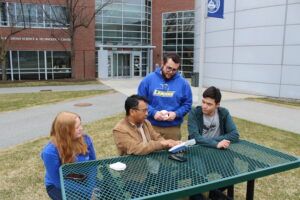
In a small room in the campus library earlier this spring, a group of Worcester State students were creating pocket-sized magazines, the kind of do-it-yourself publications known in many countercultures as “zines.”
The booklets were uniformly six pages in length, made by strategically folding a single sheet of computer paper and making one small well-placed cut. Handwritten and hand-drawn, the finished products concerned matters of political, social, and personal importance, as students filled the pages with their thoughts on everything from veganism to resources for Latine students.
“It’s cathartic in a way,” said Meghan McGrath, a senior history major who was in attendance. “The physical process is really cool. I’m also putting something I’m passionate about down on paper to share with the world.”
The project was part of the first in a new series of interactive workshops intended to bring students closer to history.
In the inaugural session, students learned about the process of archiving historic artifacts by discussing the history of zines, as well as how and why student-made publications might be preserved, then made their very own books. Subsequent workshops, as organized by the History & Political Science Department, are expected to touch on other topics, but ultimately serve the same goal of revealing how history itself is created.
“History is not about memorizing dates or studying something that’s set and settled,” said Dr. Charlotte Haller, professor of history and department chair. “Through workshops like these, we’re teaching students to approach history by thinking from multiple perspectives, asking questions, and finding evidence.”
That much was clear during the debut effort.
The first session was the result of a collaboration between Haller, Matt Bejune, executive director of the library, and student Zach Rich ’26. Rich had previously interned in the university’s archives and, while there, became familiar with its collection of zines.
Before students took to folding, cutting, and writing their own booklets, Rich led a discussion on the subject. Among other things, he covered their origins in science-fiction literary circles, their later adoption by members of punk and feminist movements, and the anticapitalist forces often behind them.
Following that, he passed around real examples of archived zines and asked students what they’d noticed about their substantive and physical characteristics. First, students noted the sociopolitical nature of each issue. Then they discussed how, unlike typical mainstream publications, the zines were all apparently xeroxed, held together with single staples, hand-written, and generally published on lower quality paper. At one point, Bejune interjected to ask whether the low-fidelity nature of the zines made their messages any less clear or resonant. The response: a uniform no.
“All of these zines come from active movements,” added Rich. “Just because something is in an archive doesn’t mean that thing is otherwise lost to time or inactive.”
Finally, students took to making their own zines and sharing what they’d created with the group. They were even presented with application forms to submit their works to be housed in the university’s archives and preserved as a palm-sized piece of Worcester State’s own history.
“This workshop was really about the archival process,” added Haller. “We took an interesting subject to show how archives are constructed, what kind of stuff might you find there, how people get things archived, and what happens to those materials once they’re there.”
Faculty are currently finalizing plans for the next workshop and plan to host at least one per semester. Haller noted they also hope to collaborate with faculty from other colleges and universities, in order to engage with the widest possible spectrum of historic expertise. Additionally, as with the first session, she hopes to continue partnering with students in relevant internships, bolstering their experiential learning by giving students the chance to help design workshops and serve as lecturers. This, she added, is at the heart of the workshops, which were conceived of at all because of how impressed faculty were with the work history students do in and out of the classroom.
“Not every workshop will have the equivalent of an art project,” added Haller. “But our goal is to make any given subject as interactive as it can be. With these workshops, we’re trying to create space on campus to celebrate the hands-on work of literally making history.”