From Worcester State to the Library of Congress
Safa Khan’s deep dive into Pakistani gender economics is now part of the national record.
By Nancy Sheehan
For many undergraduate students, summer is a time for a break from the rigors of academia. But for Worcester State University student Safa Khan, and Assistant Professor of Economics Abir Bukhatwa, the summer of 2025 was the starting point for a high-impact research journey that would lead them first to the regional stage, then the archives of the Library of Congress.
The collaboration began through the Summer Undergraduate Research Grant (SURG) program, a university initiative designed to foster close faculty-student mentorship.
Under the guidance of Dr. Bukhatwa, Khan—who had already completed three courses with the professor—embarked on a rigorous project focused on applied economic analysis. She was specifically interested in exploring how gender affects workforce participation in Pakistan.
“The project reflects the type of high-impact, student-centered work we strive to support at Worcester State,” said Dr. Bukhatwa. “It was developed through close faculty guidance, with a heavy emphasis on research design, data analysis, and the art of professional presentation.”
Reflecting on the early stages of the project, Khan said that mentorship style was instrumental in pushing her toward professional independence.
“Dr. Bukhatwa taught me that growth comes from engaging with challenges rather than waiting for perfect conditions,” she said. “She pushed me into a space where I had to rely on my own knowledge instead of just following a script. It shifted my focus from just getting an assignment done to taking true ownership of the research.”
What began as a summer research prompt quickly evolved into a sophisticated research paper. The pair’s hard work culminated this past October at the Northeastern Business and Economics Association (NBEA) conference. Standing before an audience of established scholars and industry professionals, Khan presented the findings of their analysis.
“At the start, I felt like a student stepping into a room of experts. I was so nervous I stumbled over a few words because I saw everyone else as more qualified than me,” Khan said. “But as I moved through the findings, I realized the audience was listening with real interest. I wasn’t there to prove myself; I was sharing research I genuinely cared about. At that moment, I stopped trying to earn my place and realized I already belonged there as a peer.”
According to Dr. Bukhatwa, the transition from student to professional researcher was seamless. “Safa did great,” Bukhatwa said, noting the importance of students engaging in “real-world” academic environments. This was particularly evident as Khan and Dr. Bukhatwa were refining the presentation up until the final moments.
“We didn’t even finalize my slides until twenty minutes before I went on,” Khan said. “At first, that terrified me, but it forced me to realize I didn’t need a memorized speech. I had months of problem-solving already internalized. Confidence comes from understanding the work, not from having everything perfectly laid out in advance.”
As for their findings, Khan found that both women and men in Pakistan often hold deeply traditional views about gender roles, which continue to limit women’s independence, education, and participation in the workforce.
Khan added that their co-authored paper, entitled “How Social Norms Shape Women’s Economic Participation in Pakistan,” further explored how beliefs surrounding family honor, obedience, education, domestic expectations, caregiving responsibilities, gender hierarchy, employment, financial autonomy, and marital and reproductive norms influence women’s opportunities.
“As a Pakistani woman studying my own society, it has been an eye-opening experience to understand how these norms evolve and how change can begin through awareness, empathy, and open conversation,” Khan said.
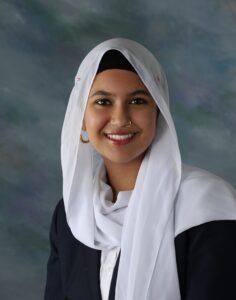
Safa Khan ’27 is a Presidential Student Ambassador, serving as a university representative on campus and in the community.
The impact of their work is now a matter of permanent record. The research has been published in the NBEA conference proceedings, which are housed in the Library of Congress. Their specific contribution can be found on page 78 of the published volume, marking a significant milestone in Khan’s early career.
“Before this, most of what I did academically felt temporary. You write it, get a grade, and move on,” Khan said. “Seeing my ideas become part of the national record changed my perspective. It showed me that my work can live beyond the classroom and actually influence how others think about economic issues. It’s given me a glimpse of what a future career in research or policy could look like.”
The success of the Bukhatwa-Khan collaboration serves as a testament to the power of the SURG program and the dedication of Worcester State faculty to go beyond the classroom. “I’m always grateful for opportunities to showcase our students’ accomplishments,” said Dr. Bukhatwa. “Seeing a student transition from the classroom to presenting at a major conference is exactly why we do this work.”